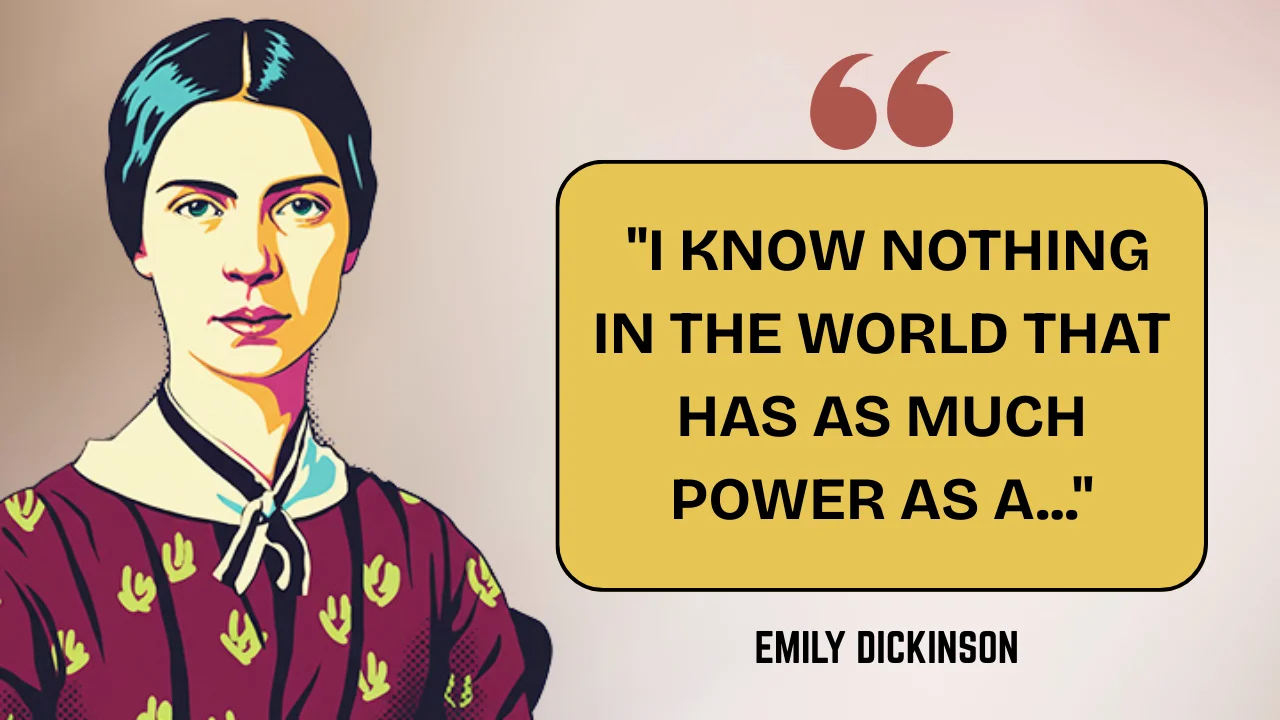
Quote of the Day by Emily Dickinson: Quote of the Day by Emily Dickinson reminds readers that the simplest words can hold extraordinary power. Emily Dickinson believed that language was not just a tool for communication but a force that shapes thoughts, emotions, and ideas. In a world where people often speak quickly and write without thinking, her words encourage us to slow down and notice how powerful a single word can be. The message behind the Quote of the Day by Emily Dickinson still feels deeply relevant today.
The Quote of the Day by Emily Dickinson continues to inspire writers, readers, and thinkers around the world. Her famous line about the power of a word reflects how carefully she approached language. Every poem she wrote showed that a few carefully chosen words can carry more meaning than long paragraphs. Understanding the story behind the Quote of the Day by Emily Dickinson also helps us understand the life, creativity, and quiet brilliance of one of the most influential poets in American literature.
Quote of the Day by Emily Dickinson
The Quote of the Day by Emily Dickinson highlights the deep respect she had for language and the creative process. She once wrote, “I know nothing in the world that has as much power as a word. Sometimes I write one, and I look at it, until it begins to shine.” This statement reveals how seriously Dickinson treated every word she used. For her, writing was not about filling pages. It was about discovering the exact word that captures a feeling or idea perfectly. This is why the Quote of the Day by Emily Dickinson continues to resonate with readers even in 2026, when communication moves faster than ever through social media, digital messages, and online platforms. Her belief reminds us that meaningful language still matters. Words can inspire hope, comfort a broken heart, or start important conversations. That timeless insight makes the Quote of the Day by Emily Dickinson a powerful reflection on the role of language in our lives.
Overview Table
| Topic | Details |
| Poet | Emily Elizabeth Dickinson |
| Birth Date | December 10, 1830 |
| Birthplace | Amherst, Massachusetts, United States |
| Profession | American poet |
| Total Poems Written | Nearly 1,800 poems |
| Poems Published During Lifetime | Around 10 to 12 poems |
| Writing Style | Short lines, slant rhyme, and unique punctuation |
| Famous Quote | “I know nothing in the world that has as much power as a word.” |
| Major Themes | Nature, death, love, identity, faith |
| Literary Impact | Influenced modern poetry and many later writers |
Emily Dickinson
Emily Dickinson remains one of the most original voices in American poetry. Although she is widely celebrated today, she lived a very quiet and private life during the nineteenth century. Most of her life was spent in Amherst, Massachusetts, where she lived with her family and focused on writing.
Her father, Edward Dickinson, was a respected lawyer and an active member of the community. The Dickinson family valued education and intellectual discussion, which helped shape Emily’s curiosity about literature and philosophy. She studied at Amherst Academy and later attended Mount Holyoke Female Seminary.
As she grew older, Dickinson gradually withdrew from public life. By her thirties, she rarely left her home. Some visitors spoke with her through a slightly open door rather than meeting her face to face. She was often seen wearing white clothing, which led some locals to refer to her as the Woman in White.
Despite this quiet lifestyle, Dickinson maintained a rich inner world filled with ideas and creativity. Her letters to friends and mentors showed that she was deeply thoughtful and intellectually engaged.

Her works- a private revolution
Emily Dickinson’s writing was largely unknown during her lifetime. Only a small number of her poems were published while she was alive, and many of those were edited heavily to match the poetic style of that era.
After her death in 1886, her sister Lavinia discovered something remarkable. Dickinson had carefully preserved nearly 1,800 poems in small handmade booklets known as fascicles. This discovery surprised the literary world.
Her poems stood out because they were different from traditional poetry of the nineteenth century. Many poets of that period preferred long and polished verses. Dickinson chose a different path by writing short poems filled with striking imagery and emotional depth.
Some distinctive features of her poetry include:
• Short and compact lines
• Slant rhyme instead of perfect rhyme
• Unusual capitalization patterns
• Frequent use of dashes and pauses
• Sudden shifts in ideas or perspective
The creative approach seen in her poems explains why readers often connect her writing with the Quote of the Day by Emily Dickinson, which emphasizes the power contained within a single word.
Her style
Emily Dickinson’s style often appears simple at first, but it carries layers of meaning. Many of her poems are brief, sometimes consisting of only a few lines. Yet those lines contain powerful emotions and thoughtful observations.

One important feature of her work is the use of hymn meter. This rhythm was common in religious songs during her time. The familiar sound of this rhythm made her poems feel musical and memorable.
Another defining feature is her use of punctuation. Dickinson frequently used dashes instead of traditional punctuation marks. These dashes create pauses that allow readers to reflect on the words and interpret their meaning in different ways.
Her writing also shows an intense focus on precision. She often spent time thinking about a single word until it felt perfect. This careful attention to language reflects the idea expressed in the Quote of the Day by Emily Dickinson, which suggests that words can shine when given enough thought.
The impact
Although Dickinson did not receive recognition during her lifetime, her influence on literature became clear after her poems were published. Editors and scholars gradually introduced her work to a wider audience.
Her poetry helped change the way people thought about writing. Instead of focusing only on elaborate language, Dickinson demonstrated that short, focused poems could carry powerful ideas.
Many later poets admired her bold style and emotional honesty. Writers such as Sylvia Plath, Adrienne Rich, and Elizabeth Bishop found inspiration in her work. Modern poets also appreciated the way she explored personal thoughts and inner emotions.
Because of this lasting influence, the Quote of the Day by Emily Dickinson is often shared as a reminder that thoughtful language can leave a powerful impression on readers.

Who was Emily Dickinson, really?
Understanding Emily Dickinson is not always simple. She has often been described as shy or lonely, but those labels only tell part of her story.
She maintained strong friendships through letters and was intellectually curious throughout her life. Dickinson read widely and followed discussions about literature, science, and religion.
Her garden also played an important role in her daily life. She enjoyed observing plants and flowers closely, and many of her poems reflect the beauty of nature. Her descriptions of nature are specific and vivid rather than general.
This deep attention to detail connects directly with the idea expressed in the Quote of the Day by Emily Dickinson. Just as she carefully observed the natural world, she also carefully observed language.
Quote of the day
The Quote of the Day by Emily Dickinson reveals her belief that words shape human experience. When she wrote that a word can shine, she was describing the moment when language perfectly captures an idea or feeling.
A word can comfort someone during grief, inspire courage during difficult times, or spark new ideas. History has shown that powerful words can influence entire societies.
Dickinson understood this deeply. Because her poems were short, every word carried great importance. She believed that writing should focus on depth rather than volume.

In today’s digital world, people share thousands of messages every minute. Yet Dickinson’s message reminds us that quality matters more than quantity. A carefully chosen word can leave a stronger impact than many careless ones.
Why she still matters
More than a century after her death, Emily Dickinson remains one of the most widely studied poets in literature. Her work continues to appear in classrooms, books, and online discussions.
Her poetry feels surprisingly modern because it is brief yet deeply thoughtful. In an age where people scroll quickly through information, her poems invite readers to pause and reflect.
The message behind the Quote of the Day by Emily Dickinson feels especially important today. It reminds us that words still carry meaning and influence. Even in a fast moving digital culture, language has the power to inspire, connect, and transform lives.
FAQs
What is the meaning of the Quote of the Day by Emily Dickinson?
The Quote of the Day by Emily Dickinson emphasizes the power of language. Dickinson believed that a single word can express deep emotions and shape how people understand the world.
Why is Emily Dickinson considered an important poet?
Emily Dickinson is considered important because of her unique writing style, emotional depth, and influence on modern poetry. Her work changed the way many writers approach language and expression.
How many poems did Emily Dickinson write?
Emily Dickinson wrote nearly 1,800 poems. Most of them were discovered after her death by her sister Lavinia Dickinson.

Why were Emily Dickinson’s poems published after her death?
During her lifetime, Dickinson preferred to keep most of her work private. After her death, her family discovered her poems and began publishing them, which introduced her writing to the world.
Why is the Quote of the Day by Emily Dickinson still popular today?
The Quote of the Day by Emily Dickinson remains popular because it highlights the timeless importance of language. In every generation, people continue to find meaning in her reflection on the power of words.